
Repair Cafés: How They Work and Why They Matter
Across the UK, repair cafés have become increasingly popular as more people look for practical ways to save money, reduce waste and make everyday items last longer.


 Home
HomePractical PAT testing guidance, equipment safety articles, and updates on UK regulations and standards.
Across the UK, repair cafés have become increasingly popular as more people look for practical ways to save money, reduce waste and make everyday items last longer.

Repair cafés can provide a useful community service by helping people keep items in use for longer. Where electrical appliances are accepted, organisers should also think carefully about electrical safety.

Awaab’s Law is about how quickly hazards must be investigated and dealt with once a landlord becomes aware of them. PAT testing is often one of the most practical ways to demonstrate that landlord-supplied electrical equipment is being managed safely.

The phrase 'PAT testing' is everywhere in the UK. It’s used by employers, contractors, training providers and test instrument manufacturers. But it’s worth understanding that PAT testing is an informal industry term, not the formal wording used by the IET Code of Practice.

PAT testing qualifications explained: what a 'competent person' means, when City & Guilds 2377 is worth it, and the best route for in-house testing, careers and starting a PAT business.

As the duty holder, you’re responsible for having a sensible system in place, even if someone else is doing the inspection and testing. The common red flags that suggest the job may not have been carried out properly.

This guide looks at the main things to consider before starting out, including training, qualifications, equipment, insurance, software, marketing, and the practical realities of winning and keeping customers.

This article explains what PAT testing records should include, how labels should be used, and why recording failed items properly is just as important as recording passes.

This page brings together real examples of unsafe electrical equipment discovered during PAT testing and inspection.

In this article, we will demonstrate how to PAT test some common appliances. From kettles and TVs to laptops and phone chargers, this article will provide a guide on how to PAT test these frequently queried items.

This study guide is for the City & Guilds 2377-77 award for the In-service Inspection and Testing of Electrical Equipment. This qualification is designed for individuals responsible for overseeing the maintenance of electrical equipment, as well as those undertaking the practical inspection and testing of electrical equipment, commonly known as PAT Testing.

When it comes to electrical safety, we often encounter terms such as basic protection, fault protection, and various classes of equipment like Class I and Class II. In this article, we'll break down these terms, explore how different classes of equipment safeguard users from electric shocks, and provide typical examples of items falling under each class.

There is no specific law that states landlords must carry out “PAT testing” at fixed intervals. However, landlords have a legal duty to ensure that any electrical equipment they supply as part of a tenancy is safe.

Yes, for many workplaces it’s the simplest way to keep control of electrical safety: you can test equipment when it suits you, reduce downtime, avoid missed items, and maintain standards.

Among the myriad of items donated to charity shops, second-hand electrical equipment is a popular category. However, selling such items also brings unique responsibilities and safety concerns.

If you carry out Portable Appliance Testing (PAT) on a regular basis, a few simple accessories can make the job quicker, safer and more comfortable.

This article highlights some common errors made during PAT testing and explains how to avoid them.

Although a multimeter can measure resistance, it cannot replicate the test currents, test voltages or measurement accuracy required for effective portable appliance testing.

PAT testing should not cause damage. Problems usually arise when the wrong test is applied to the wrong type of equipment (for example, high-current bond testing on sensitive electronics, or powering the wrong voltage during a leakage test).

With the recent increase in electricity prices, we are all looking at ways to reduce our energy bills and there are plenty of sites offering useful advice and tips. In this article, we will try and put some actual figures on the amount of savings that can potentially be made.

This guide is for duty holders and managers responsible for electrical safety. Whether PAT testing is outsourced or done in-house, you’re responsible for having a sensible system in place: deciding what is included, setting risk-based frequencies, making sure defects are reported, and keeping enough records to show due diligence.

Plug-in energy saving devices will not reduce your household electricity bill. These energy saving devices are a scam. Independent tests have shown these devices have serious safety defects.

A user check is a simple visual inspection carried out by the person using the equipment. It forms an important part of the overall maintenance system required to comply with the Electricity at Work Regulations, alongside formal visual inspection and electrical testing.

How often PAT testing should be carried out depends on a suitable risk assessment. The right inspection and test interval is determined by the environment, the equipment type, the way it is used, who uses it, and what you have found previously.

This flame test shows why counterfeit plugs are so dangerous. During PAT testing it’s not unusual to find overheated or melted plugs, often caused by loose terminals, poor connections or overloading.

The UK Conformity Assessed (UKCA) mark is the UK’s product conformity mark for goods placed on the market in Great Britain (England, Scotland and Wales). It was introduced after Brexit to replace the CE mark in Great Britain, but UK government guidance now allows continued use of CE marking for most goods indefinitely, alongside UKCA.

The IET Code of Practice for In-Service Inspection and Testing of Electrical Equipment is the main UK guidance document used for portable appliance testing (PAT). It sets out best practice for carrying out a combined visual inspection and (where appropriate) electrical testing, along with guidance on test methods, limits, record keeping and how to apply a risk-based approach.

This article explains exactly what falls within the scope of PAT testing, what does not, and where common misunderstandings arise.

This guide explains the basic UK requirements for making and selling mains-powered lamps, what evidence you should keep, and what routine tests you should perform during manufacture.
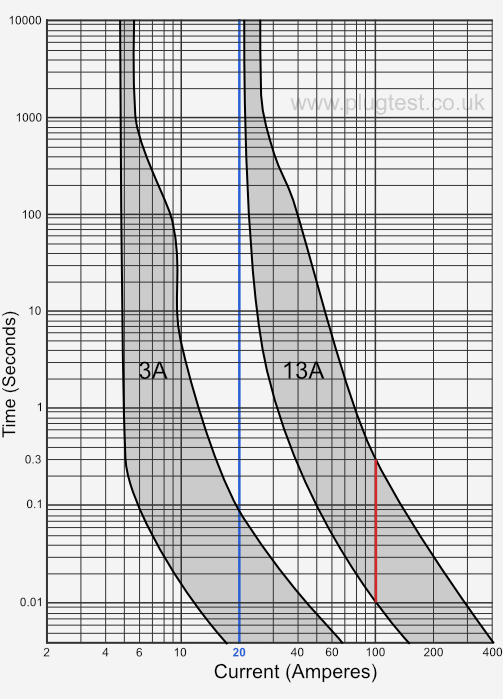
A common misunderstanding is that a 13A fuse is designed to blow at 13A. This is not the case. Under BS 1362, the rated current of a fuse is the current it can carry continuously without exceeding its permitted temperature rise. In practice, a 13A fuse can carry approximately 20A for a significant period without operating.

These fuses do not comply with BS 1362 and represent another example of the counterfeit and unsafe electrical accessories increasingly encountered during inspection and PAT testing.

Many types of electrical equipment cannot be connected directly to a PAT tester because they are fitted with industrial plugs, three-phase connectors, or other non-standard connectors instead of a 13A plug. In these situations, adaptors are used to allow safe inspection and testing.

Socket covers (also known as socket protectors or socket inserts) are widely marketed as a child safety product. However, electrical safety experts warn that they can make UK plug sockets less safe rather than more safe. In fact, several organisations have issued safety notices advising against their use.

If you're considering a career as a PAT tester, this guide explains what the job involves, the qualifications employers look for, the training required and how to find work in the industry.

The Seaward Primetest 250 and the Megger PAT150 are both small, battery-powered PAT testers designed for straightforward in-service testing. This comparison focuses on practical testing and usability in real-world PAT work, not just a spec sheet.

This case study underlines the importance of formal visual inspection and shows that where inherent design or construction faults are identified, the item should be failed and not subjected to further testing.

Learn how a plug pin gauge (Plug Checker) helps identify counterfeit and unsafe BS1363 plugs and chargers. A useful tool during PAT testing visual inspection.

Seaward introduced the Apollo 400 as a “straightforward, no-nonsense” PAT tester. It sits in the Apollo range as a practical, mid-volume tester with a strong focus on usability and record keeping.

One part of Portable Appliance Testing (PAT testing) that’s becoming increasingly important is spotting counterfeit and non-compliant electrical accessories, particularly plug fuses.

This article summarises the main calibration options, what to check between calibrations, and what to do about calibration reminder messages on some testers.

The leakage test can be used as an alternative to the insulation test. It's a useful test to perform where an appliance has an electronic switch that requires mains power to operate, or for equipment containing surge protection circuits.

The Code of Practice for In-Service Inspection and Testing of Electrical Equipment was first published in 1994 by the IEE (Institution of Electrical Engineers). By the time the 4th edition was published in 2012, the organisation had become the IET (Institution of Engineering and Technology).

The IET Code of Practice recommends that test instruments are checked at regular intervals between calibrations. This helps confirm that the instrument is still performing as expected, rather than relying only on the annual calibration certificate.

Travel adaptors allow electrical equipment fitted with a foreign plug to be connected to a UK socket. However, they must be correctly designed to provide protection equivalent to a standard BS 1363 plug.

A centrally tapped 110V transformer provides a split phase which reduces the line-to-earth voltage to just 55V. As the majority of electric shocks are caused by touching a line conductor whilst also in contact with earth (line-to-earth), this reduced voltage is significantly safer than the standard mains supply.

Counterfeit and substandard mobile phone chargers (and other AC adaptors) are widely sold online, particularly via marketplaces such as eBay. This matters during PAT testing because a charger can look fine externally yet have serious safety defects internally.

The Code of Practice requires an earth continuity test on all exposed metal parts. The key word here is ‘exposed’. An exposed metal part, is a metal part that a user could come in contact with.

A tester that only shows pass/fail can hide borderline results, give misleading passes, and make it difficult to demonstrate that testing has been carried out correctly.

During a PAT inspection it’s common to find equipment with missing, suspicious, or incorrectly printed conformity marks. A frequent question we get is: 'Should an item fail a PAT test if it does not have a CE mark?'

The City & Guilds Qualified logo is designed for learners who have achieved a City & Guilds qualification and want a clear way to showcase that achievement on a website, vehicles, or marketing materials.

In 1984, BS 1363 was amended to require insulation sleeves on the line and neutral pins. More than 30 years later, equipment fitted with non-sleeved plugs is still found in use. What should be done if a non-sleeved plug is found during a PAT inspection?

Medical electrical equipment is outside the standard PAT testing procedures described in the IET Code of Practice and should not be tested using standard PAT methods. Instead, it is inspected and tested to IEC 62353.

PAT testing isn’t just theory. It’s a practical skill involving visual inspection, correct test selection, safe working practices, and the confidence to interpret results and make the right decision when something doesn’t look right.

Many PAT testers run a quick pre-check before the insulation test. If the appliance appears to be switched off (or the tester can’t “see” a load through the plug), the instrument may show a warning.

Conformity marking is mandatory on electrical appliances in many countries. These symbols indicate that a product complies with a specific standard.

The limit for the Earth Continuity Test is (0.1 + R)Ω. Where the R value is the resistance of the protective conductor (earth wire) within the supply cable.

A common cause of electrical faults is an incorrectly wired plug. Wiring a plug is not difficult however it is important to get it right.

Label printers can feel like a productivity upgrade, but they don’t always speed up real-world testing. Many experienced PAT technicians apply a pre-printed label while the tester is still running the test sequence.

Under BS 1363-1, a plug fitted with an ISOD must be of a non-rewirable (moulded) type. The reason is safety: a rewirable plug could be removed and reused on another appliance. If that appliance were Class I equipment requiring a protective earth connection, the ISOD would not provide an earth path.

An electric shock can kill or seriously injure and is one of the hazards that electrical safety legislation is intended to protect against. Understanding how electric shock occurs is fundamental to safe inspection and testing procedures.

Research by Electrical Safety First estimates that around 4 million recalled electrical appliances are still being used in UK homes and businesses. The average success rate of a product recall is typically between 10% and 20%, meaning the vast majority of unsafe products remain in circulation.

Microwave leakage testing is not part of the standard electrical safety checks carried out during PAT testing, but it is often performed alongside the PAT test as an additional safety check.

PAT testing is not a legal requirement. However, the law does require electrical equipment used at work to be maintained in a safe condition. PAT testing is simply one recognised method of checking equipment to confirm it is safe to continue using, or that maintenance is needed.

Visual inspection is where many PAT test failures are found, and one of the easiest ways to improve your inspection skills is to become familiar with a wide range of plug and socket types, including older and uncommon designs.

The purpose of the fuse within a UK plug is to protect the cable. It is a deliberate weak link designed to melt in the event of a fault, thus cutting the power supply. The fuse's current rating must be lower than that of the cable. This is to ensure that the fuse will fail first to prevent the cable from overheating.

Before inspection and testing can begin, the equipment must be safely isolated from the supply. With plug-in equipment this is usually as simple as unplugging it. With fixed equipment, isolation is more involved, and that’s why it’s commonly overlooked.

Anyone selling second-hand electrical equipment in the UK has a legal responsibility to ensure that the equipment is safe. This applies whether you are a charity shop, landlord, online seller, school, business or private trader.

Test your basic electrical knowledge - 10 multiple choice questions on Power, Voltage, Current & Ohm's Law.

The term Portable Appliance Testing (PAT) often causes confusion. It’s not limited to items you can carry. The IET groups electrical equipment into categories. These categories are mainly used to help decide suitable inspection and test frequencies, and in some cases they can also affect which tests are carried out and what limits apply.