

 Home
HomePAT Testing with Adaptors
Many types of electrical equipment cannot be connected directly to a PAT tester because they are fitted with industrial plugs, three-phase connectors, or other non-standard connectors instead of a 13A plug. In these situations, adaptors are used to allow safe inspection and testing. This article explains how adaptors are used for PAT testing 230V, 110V and three-phase equipment, and the important safety considerations when testing this type of equipment.
Once connected using the correct adaptor, the inspection and electrical tests are carried out in exactly the same way as for any other appliance. The adaptor simply provides a safe interface between the appliance connector and the PAT tester, allowing earth continuity, insulation resistance and polarity tests to be performed.
It’s important to recognise that not all equipment can be connected directly using an adaptor. Some appliances are wired permanently via a fused spur rather than fitted with a plug. In these cases, the supply must be isolated safely before inspection and testing can take place. See our guide to fixed equipment isolation for further information.

230V Adaptors
The most commonly encountered non-standard 230V connectors include IEC 60309 industrial connectors and BS 546 round pin plugs. Although BS 546 connectors have largely been replaced by the 13A plug, they are still widely used for lighting circuits, particularly where lamps are connected to switched lighting systems or dimmable stage lighting.


IEC 60309 (CEE) Industrial plugs are used on a wide range of equipment. Typically industrial equipment that requires more than 13A, or protection from water ingress. These connectors are available in 16A, 32A, 63A and 125A ratings, but 16A and 32A are the most frequently used.
For testing extension leads, an extension adaptor is also required. This connects the trailing socket end of the extension back into the IEC socket on the PAT tester to allow an earth continuity and polarity test to be carried out.

Another commonly used 230V adaptor is the C5 (cloverleaf ߷). C5 IEC leads are typically found on IT equipment and require an adaptor to connect the cloverleaf style connector to the IEC socket on the PAT tester to carry out an earth continuity and polarity test.
110V Adaptors
110V equipment is widely used on construction sites and in other high-risk environments because it reduces the risk of electric shock. Like 230V equipment, it can be connected to a PAT tester using a suitable adaptor. However, different test considerations apply, and a standard 230V leakage or load test should not be performed on 110V equipment as this may damage the appliance. See our guide to PAT testing 110V equipment for detailed guidance.


Some PAT testers, such as the Metrel BetaPat, have a built in 110V socket and do not require an adaptor to connect 110V equipment. The BetaPat requires a 110V power adaptor to power up from a 110V supply and can perform a 110V leakage and load test. To connect a 32A 110V plug to the BetaPat, a 16A to 32A adaptor is required.


3-Phase Adaptors
3-Phase equipment can also be tested using an adaptor. 3-Phase connectors are available in 4-pin and 5-pin variations, with 16A and 32A sizes the most commonly used, although again 63A and 125A are also available. A PAT tester can only carry out an earth continuity and insulation test on 3-phase equipment. Generally extension adaptors are not used for extension leads as the PAT tester can not carry out a 3-phase polarity test. The earth continuity on an extension lead can be measured by connecting the test probe to the earth pin in the trailing socket.


Uncommon Connectors


Uncommon connectors are often found during PAT testing. For example, variations on the standard 13A plug are sometimes used to prevent the connection of unauthorised equipment in sensitive areas such as server rooms.
BS 196 industrial connectors, although mostly superseded by CEE connectors, are still occasionally encountered whilst PAT testing.
If a suitable adaptor is not available, it may be possible to carry out limited testing using a break-out socket adaptor and test leads. This method allows access to the individual conductors so that earth continuity and insulation resistance tests can be performed. Safety note: This method leaves live conductors exposed and must be approached with caution. It should be restricted to earth continuity and insulation resistance testing. Leakage and load tests must not be carried out using this arrangement. During an insulation test, the PAT tester internally connects the line and neutral conductors together. For additional safety, the test leads can be connected between the neutral and earth conductors only, as shown in the example below. This avoids unnecessary exposure to the line conductor while still allowing the integrity of the insulation and earth connection to be verified.


Training
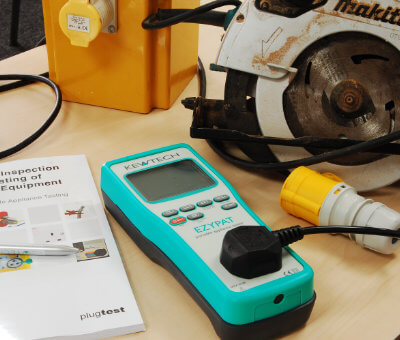
If you need to PAT test equipment fitted with industrial connectors or other non-standard plugs, it is important to understand both the correct test procedures and the limitations of the test equipment. This includes selecting the correct adaptor, choosing appropriate test settings, and recognising when additional precautions are required. As a specialist PAT testing training provider, our courses include practical training using a wide range of adaptors and equipment commonly encountered in real workplaces. You will gain hands-on experience testing extension leads, industrial equipment, IT equipment and 110V tools, and learn how to safely test equipment that cannot be connected directly to a standard 13A PAT tester socket.
We run regular courses at venues across the UK, as well as providing onsite training tailored to your organisation. Onsite training is particularly useful where specialised equipment or uncommon connectors are used, as the training can be based around your actual appliances and working environment.
PAT Testing Adaptors
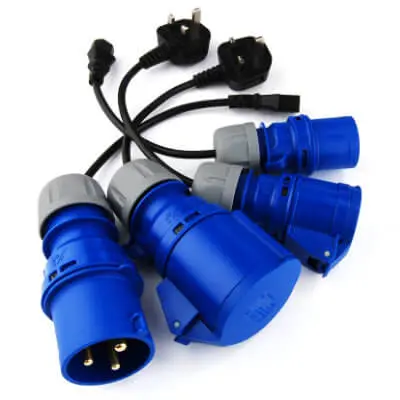
Using properly constructed adaptors is essential to ensure safe and reliable testing. We supply a range of PAT testing adaptors suitable for 230V, 110V and three-phase equipment. These are built using high-quality BS EN 60309 industrial connectors manufactured by PCE, a well-established European connector manufacturer. Using correctly specified adaptors helps ensure accurate test results and reduces the risk of damage to equipment or the PAT tester.