

 Home
HomeCounterfeit BS 1362 Fuses
One part of Portable Appliance Testing (PAT testing) that’s becoming increasingly important is spotting counterfeit and non-compliant electrical accessories, particularly plug fuses. Because plug fuses are inexpensive and easy to ship, they’re widely sold online, and they can look convincing until you examine them closely.
Key takeaways
Visual inspection is essential. Counterfeit BS 1362 fuses can appear convincing externally but often have incorrect markings, unusual end caps, wrong dimensions, or missing sand filling.
Counterfeit fuses may not provide proper protection. A fuse that does not operate correctly during a fault can allow excessive current to flow, leading to overheating, fire, or damage to equipment.
If in doubt, replace the fuse. Always use compliant fuses from a reputable electrical supplier. Avoid unbranded or unusually cheap products sold via online marketplaces.
Further guidance: see our articles on selecting the correct fuse rating and fuse operation characteristics.

To show how common this can be, we randomly purchased four packs of BS 1362 plug fuses from eBay and inspected them against the markings and basic construction features you’d expect to see on compliant fuses.
If you want an overview of other real examples we’ve found during inspection and PAT testing, see our page on counterfeit and dangerous electrical equipment.

The first is an unbranded blue and grey pack containing four 13A fuses. The pack is clearly labelled with 'Approved to BS 1362'. Each fuse is marked with 'Bussmann' and the ASTA approval mark. (Cooper Bussmann is a leading brand of fuses.)

Even before the pack is opened, it is immediately apparent that these are counterfeit. There is a clear gap between the metal end caps and the ceramic body. The fuse wire can also be seen trapped between the cap and body causing a bulge in the metal. A genuine BS 1362 fuse has the internal wire connected to an eyelet inside the centre of the cap.

The shiny metal end caps are also a good indicator that the fuse is not genuine. The end cap on the genuine Cooper Bussmann fuse is not as shiny. This fake fuse also has a larger than normal dimple in the end of the cap.
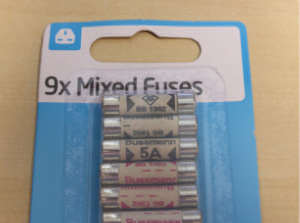
The second pack contains 9 mixed fuses in a blue unbranded pack with a plug logo in the corner. These fuses are again labelled as Bussmann and marked with the ASTA approval symbol.

The end caps are shiny metal with a larger than normal dimple, so I suspect that these are also counterfeit. However there is no gap between the end cap and body, or evidence of a trapped wire. The length of the fuse is noticeably smaller than the genuine Cooper Bussmann.

The length of the fuse measures 24.91mm. A BS 1362 fuse should have a length of 25.4mm with a tolerance of +0.8/-0.4mm, so this fuse does not meet the dimension requirements.


The combined weight of the 9 fuses is 18g. The weight of 9 genuine fuses on the same scales is 23g. This indicates that they probably do not contain the required sand filling.

Breaking the fuse open confirms that these fuses are counterfeit. There is no sand filling. The quartz sand inside a genuine BS 1362 is designed to control the rupture of the fuse wire within the ceramic body.
The genuine 13A Bussmann fuse also has a solder bead on the fuse wire which is missing on the fake.

The third pack is branded as Eurosonic and contains 8 mixed size fuses.
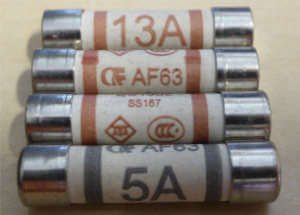
The fuses have the ASTA approval symbol and appear to be branded 'CF' and marked AF63. (A BS 1362 fuse must have the manufacturer's name or identifying mark.) They also have a number printed on them: SS157.

The 3A and 5A fuses also have larger than normal dimples on the caps. A requirement of BS 1362 is that "The end surfaces shall be substantially flat". There is no evidence of a trapped fuse wire, although the large dimples indicate that these could also be fake.

The fuse meets the dimension requirements of BS 1362.

Breaking the fuse open shows it has a sand filling. So it appears that this pack does meet the requirements of BS 1362. Although I'm not sure that the end caps of the 3A & 5A fuses would be considered as substantially flat.

The final pack is yellow labelled ‘Universal’ and contains three 13A fuses.

The fuses are branded as Richstar and have the ASTA and Kite marks. The end caps have a dull matt finish. These look to to be genuine. There is also an ASTA licence number:497 and a Kitemark number: KM34254. BEAB website and BSI certificate search both have a search facility to check the licence numbers. I couldn't find a matching licence on either site. I contacted BSI and they confirmed that the Kitemark number is not registered and the fuse should be considered as counterfeit.


The dimensions meet the BS 1362 requirements and it also contains a sand filling. If it were not for the incorrect licence numbers being printed on the fuse, there would be no reason to suspect that these were counterfeit.

Unfortunately this proves how difficult it is to tell the difference between counterfeit and genuine BS 1362 fuses. The ASTA, BSI or Nemko approved symbols do not prove authenticity.
If you are purchasing fuses online, we recommend only using a reputable supplier such as RS Components or Farnell. Both of these companies are able to provide data sheets and compliance documentation for the products they sell. Identifying counterfeit electrical equipment is becoming an important part of the inspection process and is something that we cover on our PAT training courses.
Even with genuine fuses, selecting the correct rating matters. See our guide on selecting the correct plug fuse rating, and our explanation of how fuses operate under overload conditions.
Counterfeit BS 1362 Fuse Testing
Trading Standards report that counterfeit fuses "may explode violently and may blast the top of the plug or blast the plug from the socket”.
So we decided to put a counterfeit fuse to the test! This is the result of deliberate short circuit across the line and neutral conductors in an IEC cord fitted with a fake 3A fuse from the second unbranded pack. The plug was not blasted from the socket, but the fuse exploded and left a scorch mark on the socket outlet!


Below is a video of a fake fuse in operation during the short circuit. This is a 5A fuse taken from the second pack connected to a standard 230V ring circuit protected by a 32A MCB.
Conclusion
This investigation shows how difficult it can be to distinguish between genuine and counterfeit BS 1362 fuses. Some counterfeit products display convincing markings and approval symbols, yet fail to meet the construction and performance requirements of the British Standard.
A fuse that does not operate correctly during a fault may allow excessive current to flow, increasing the risk of overheating, fire, or damage to the appliance and supply cable. Visual inspection and the use of approved components from reputable suppliers are essential to ensure safety.
See our guide to counterfeit and dangerous electrical equipment for further real-world examples identified during inspection and PAT testing.