

 Home
HomeElectrical Safety: A Guide for Repair Café Organisers

Repair cafés can provide a useful community service by helping people keep items in use for longer. Where electrical appliances are accepted, organisers should also think carefully about electrical safety. This article is not legal advice. It is intended as practical guidance to help organisers think about safe working and sensible boundaries when dealing with electrical items.
These events often involve mains-powered items such as lamps, kettles, toasters, radios, vacuum cleaners and other small domestic appliances. Faults may be obvious, but appliances can also have damage or deterioration that is less visible. An item may appear to operate normally and still present a risk of electric shock or fire.
Why electrical safety needs to be considered
A repaired appliance should not be handed back purely on the basis that it powers up or appears to work. Damage to a plug, incorrect fuse protection, poor cord anchorage, deterioration of a flexible cable, missing covers, loose internal connections or damage to accessible parts can all affect safety.
For that reason, it helps to think in advance about what checks are appropriate, which types of appliance volunteers are comfortable dealing with, and when an item should be refused or set aside as outside the limits of the event.
Set clear limits for electrical repairs
One of the most practical steps is to define what kinds of electrical work will and will not be carried out. Some events may be comfortable dealing with simple faults such as replacing a plug, fitting the correct fuse, re-terminating a damaged cable, or replacing a flexible lead where appropriate. More complex internal repairs may require a higher level of knowledge and experience.
It is also important to assess the appliance as a whole, not just the fault that stops it working. A defect may be repairable, but if the appliance also has other damage that affects safety and cannot be properly remedied, it should not be returned to service. Repair should not be limited to restoring function alone.
Having clear limits helps reduce the chance of unsuitable repairs being attempted. It also helps volunteers work within sensible boundaries and makes it easier to explain to visitors why some items can be looked at and others cannot.
What we recommend you do not do:
- No internal repairs on mains equipment unless the volunteer is appropriately skilled and confident.
- No modifications, bypassing interlocks, or “making it work” repairs.
- No repairs where a single fault has been corrected but other damage remains that affects the safety of the appliance.
- No repairs to items showing signs of heat damage. These should normally be failed and replacement advised.
Practical visual inspection checklist:
- Plug and flex condition, including cuts, crushing, overheating or taped repairs.
- Correct fuse fitted and secure cord grip where a rewirable plug is used.
- Casing condition, including cracks, damage, and missing screws or covers.
- Signs of overheating such as smell, discolouration or melting.
- Suitability of the item, including wet or damp use, heaters, high-power items, or obvious DIY modifications.
Volunteer competence is important
Electrical work should only be carried out by somebody who is competent to do it. In this environment, competence may vary considerably from one volunteer to another. Some may have practical experience of appliance repair or electrical maintenance, while others may only be comfortable with straightforward external checks.
Organisers should avoid assuming that a general interest in repair is enough on its own. Anyone carrying out electrical repairs or tests should understand the type of appliance being worked on, the likely faults, the safety implications of the repair, and the limits of their own experience.
As a minimum, if someone is not confident identifying Class I and Class II equipment, or wiring a plug correctly, they should not be carrying out electrical repairs.
Where electrical testing fits in
If work is carried out on a mains-powered appliance, it is good practice to carry out suitable electrical tests before returning it to service. A repair can disturb wiring and internal connections, and it will not always be obvious from appearance alone whether the appliance remains electrically safe. Testing can therefore form part of the final safety check, helping to identify issues such as damaged insulation, poor terminations or a disconnected earth that might otherwise be missed. Depending on the type of appliance, this may include earth continuity, insulation resistance or leakage testing.
Testing should not be seen as a substitute for inspection or competence. It is one part of deciding whether an appliance is safe to return to use, alongside visual checks and a proper understanding of the appliance itself.
For anyone wanting a broader overview of the practical process, our guide on how to PAT test walks through the testing of some common appliances and may help give additional context.
What test equipment is needed?
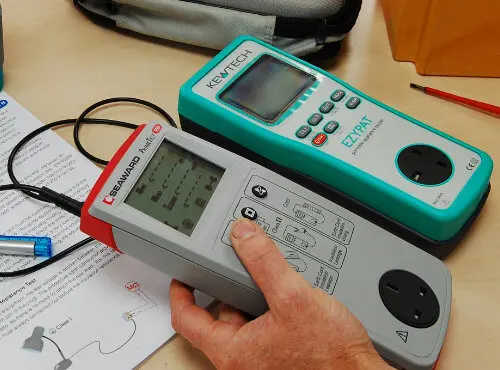
The most practical way of carrying out final electrical safety tests is with a PAT tester. There are various types available, from simple testers through to more advanced models that store results.
For this type of use, a basic tester is usually sufficient, but it should display the actual measured values rather than just a pass/fail indication. Being able to see and interpret the reading matters, especially for earth continuity, where lead resistance and contact quality can affect the result. For most repair café use, there is usually no need for many of the data-logging features of more advanced testers.
We would generally avoid pass/fail-only “checker” instruments, because they can hide borderline readings and make it harder to confirm what was actually measured.
It may also be tempting to think that the electrical safety tests can be carried out with a simple multimeter, the type used to help fault finding during repair work. However, these are generally unsuitable for safety testing. We cover this in more detail in our article on whether a multimeter can be used for PAT testing.
If you are choosing a tester, our guide to choosing a PAT tester explains the main tester types and the features that matter in practice.
Training for repair café teams
For groups that regularly deal with mains-powered appliances, some form of training may be helpful. This can give volunteers a better understanding of visual inspection, common electrical faults, appropriate test methods and the limits of what should and should not be done in this setting.
We provide tailored onsite PAT testing courses for organisations and community groups, including repair cafés. We have experience of delivering training for teams, with an emphasis on practical electrical safety, suitable post-repair checks and the types of appliances commonly seen at community repair events.
Simple procedures can help
It is often sensible to have a basic procedure for electrical items. This may include noting the reported fault, recording what work was carried out, identifying who worked on the item, and confirming what inspection or testing was completed before the item was handed back.
Simple records can help volunteers work more consistently and can make it easier for organisers to review how electrical items are being dealt with. A straightforward booking-in or disclaimer form may also help visitors understand that not every item can be repaired or safely returned to use.
Know when an item should not be returned
One of the most important decisions is recognising when an appliance should not be handed back as fit for continued use. This may be because a fault remains, because the condition of the appliance is poor, because suitable checks could not be completed, or because the item is simply beyond the limits of the event.
That decision should be seen as part of good practice, not as a failure. Repair cafés are valuable because they encourage repair and reuse, but safety should always come first.
Final thoughts
Where electrical appliances are accepted, organisers should think carefully about volunteer competence, visual inspection, testing and safe limits on the type of work undertaken. A repaired appliance should only be returned to use where there is a reasonable basis for concluding that it is safe.
Clear boundaries, practical procedures and appropriate knowledge can help these events deal with electrical items more safely and more consistently. That in turn supports the wider aim of keeping useful items in service responsibly.